
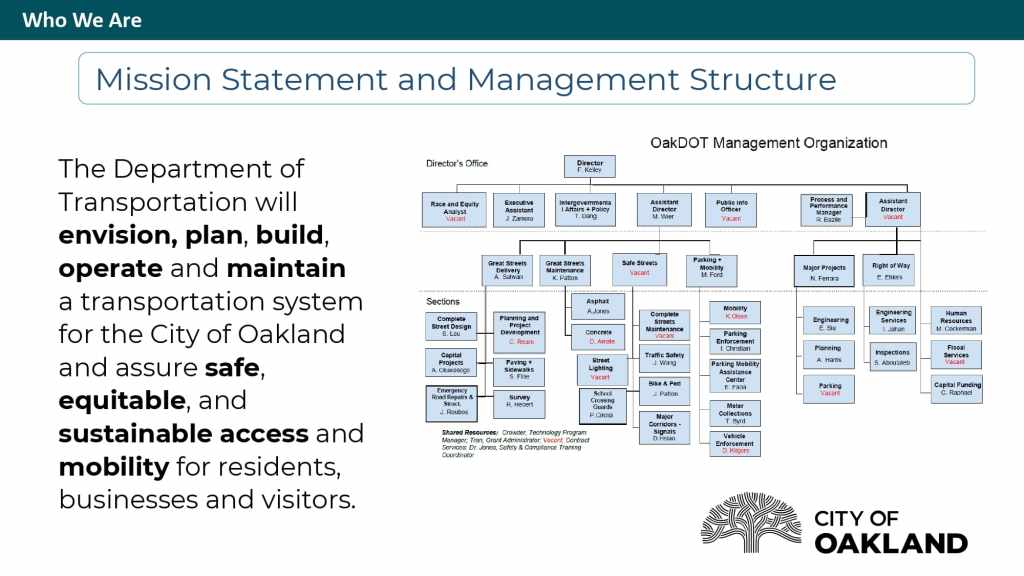
At the June 15, 2023 BPAC meeting, Fred Kelley, OakDOT Director, Megan Wier, OakDOT Assistant Director, Craig Raphael, OakDOT Senior Transportation Planner, and Tony Dang, OakDOT Policy & Intergovernmental Affairs Senior Advisor, will provide an update on the Fiscal Year 23-25 budget process that is underway, including updates on department leadership, the vacancy rate, organizational challenges, and recent accomplishments.
An excerpt of the presentation is below, followed by the full presentation.
Barriers to Delivering our Mission
- High vacancy rate (currently 30%)
- Impacted by baby-boom generation employees reaching retirement age and macro-economic conditions facing the city
- Prioritizing investments
- We must continue to prioritize improvements based on limited staffing resources and high demand and need to be transparent that there are tradeoffs in our delivery of services.
- Contracting challenges
- In the area of procurement of materials, professional services and construction, policymakers could provide more administrative authority, particularly for priority activities.
- Policy needs
- New policies, like automated speed enforcement with strong equity and privacy protections, if authorized at the state level, could calm traffic and lead to more equitable outcomes on our High Injury Networks.
FY23-25 Operating Budget Proposal Highlights
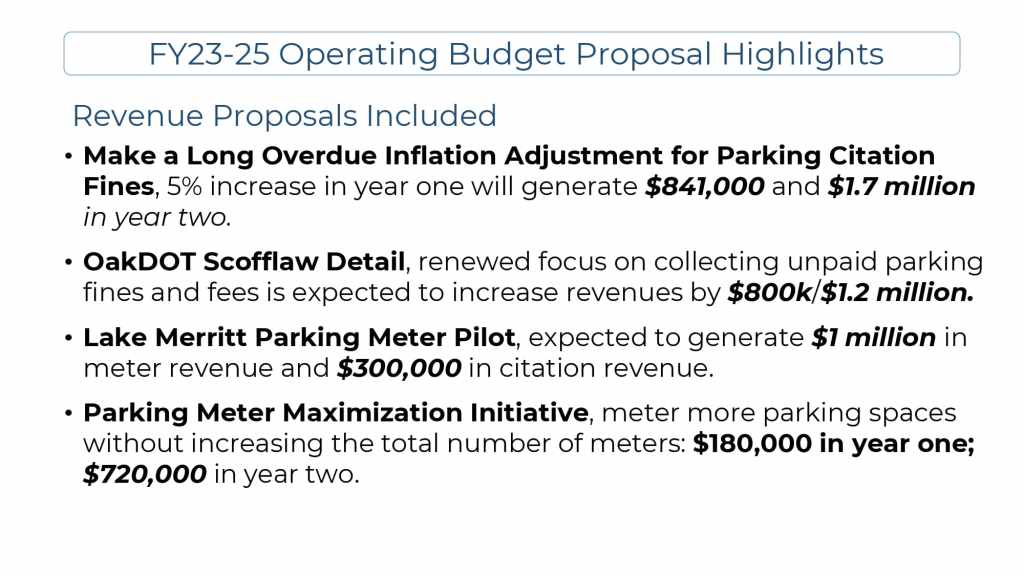
Revenue proposals included:
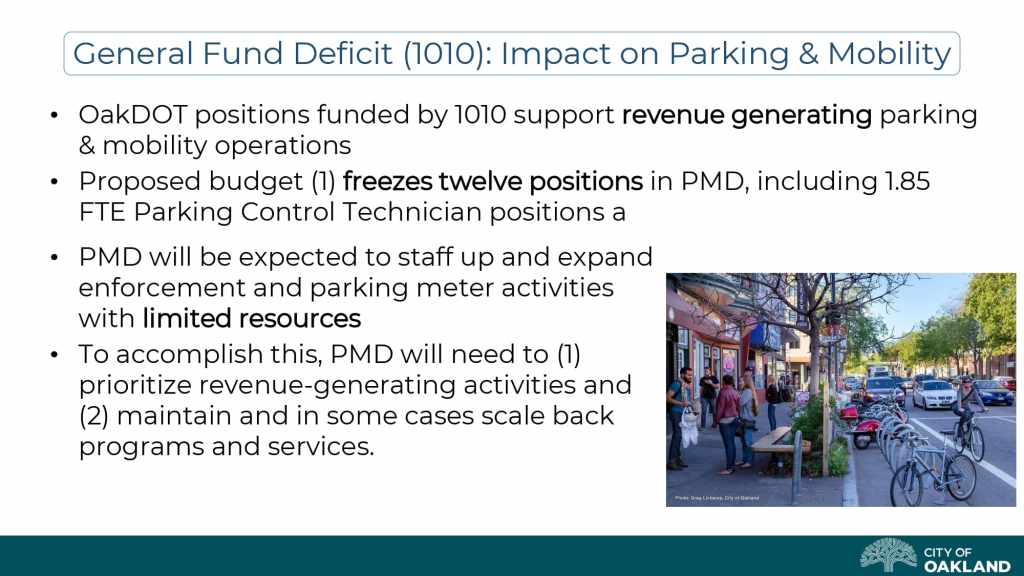
- Make a Long Overdue Inflation Adjustment for Parking Citation Fines, 5% increase in year one will generate $841,000 and $1.7 million in year two.
- OakDOT Scofflaw Detail, renewed focus on collecting unpaid parking fines and fees is expected to increase revenues by $800k/$1.2 million.
- Lake Merritt Parking Meter Pilot, expected to generate $1 million in meter revenue and $300,000 in citation revenue.
- Parking Meter Maximization Initiative, meter more parking spaces without increasing the total number of meters: $180,000 in year one; $720,000 in year two.
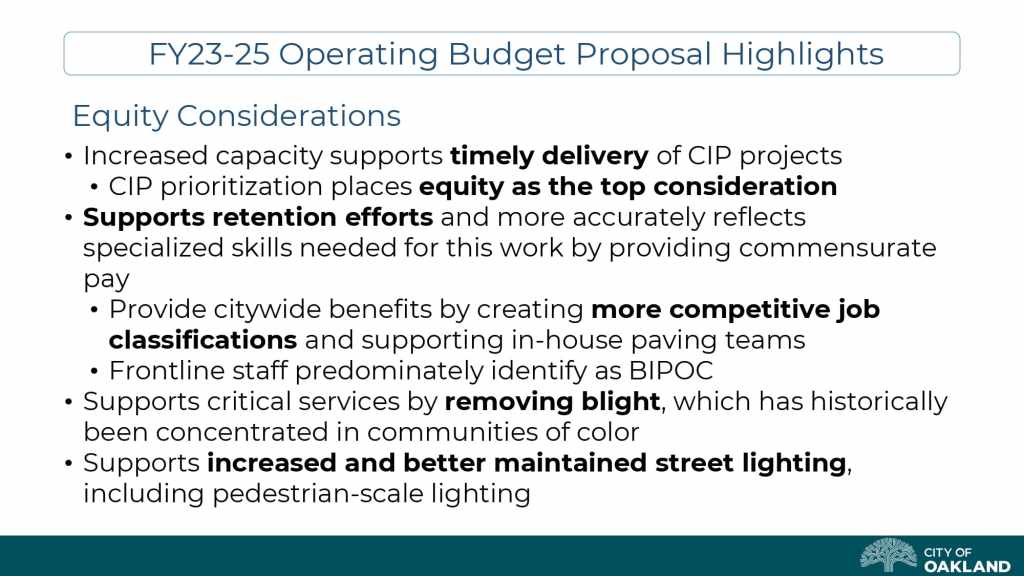
Equity considerations:
- Parking fees and citations disproportionately impact low-income and car-dependent BIPOC Oaklanders
- Parking citations fees are regressive and do not factor in income level • May allow for more frequent street sweeping and therefore reduce blight and improve stormwater pollution prevention practices
- Disincentivizes driving
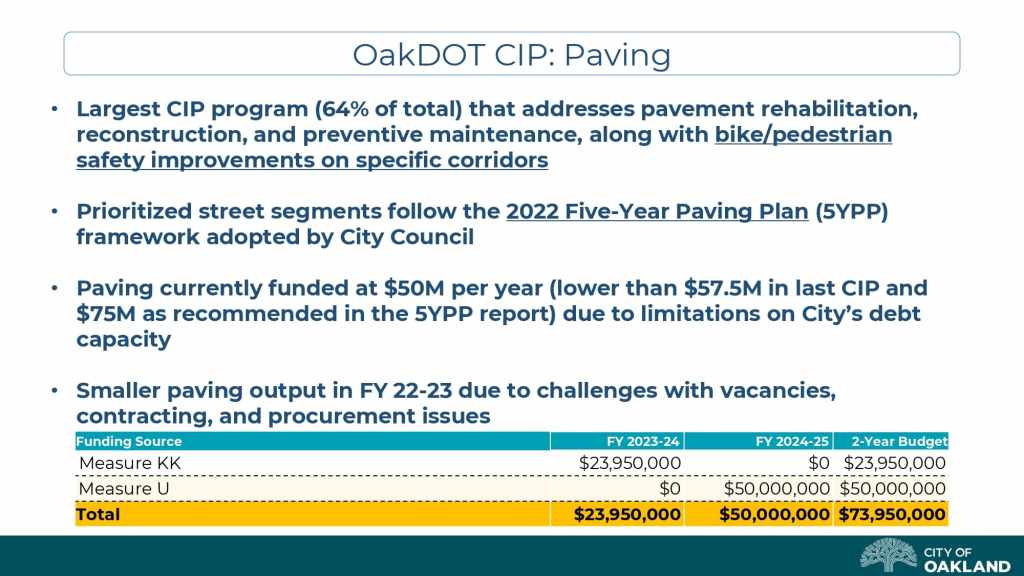
OakDOT CIP Paving
- Largest CIP program (64% of total) that addresses pavement rehabilitation, reconstruction, and preventive maintenance, along with bike/pedestrian safety improvements on specific corridors
- Prioritized street segments follow the 2022 Five-Year Paving Plan (5YPP) framework adopted by City Council
- Paving currently funded at $50M per year (lower than $57.5M in last CIP and $75M as recommended in the 5YPP report) due to limitations on City’s debt capacity
- Smaller paving output in FY 22-23 due to challenges with vacancies, contracting, and procurement issues
Presentation






 Oakland BPAC Blog