
At the November 2, 2023 BPAC Infrastructure Committee meeting, AC Transit Transportation Planner Crystal Wang provided an introductory overview of their Transit Supportive Design Guidelines, an update to the agency’s current Multimodal Corridor Guidelines [PDF].
An excerpt of the presentation is below, followed by the full presentation [0.5MB PDF], presentation notes, and discussion notes.
Background
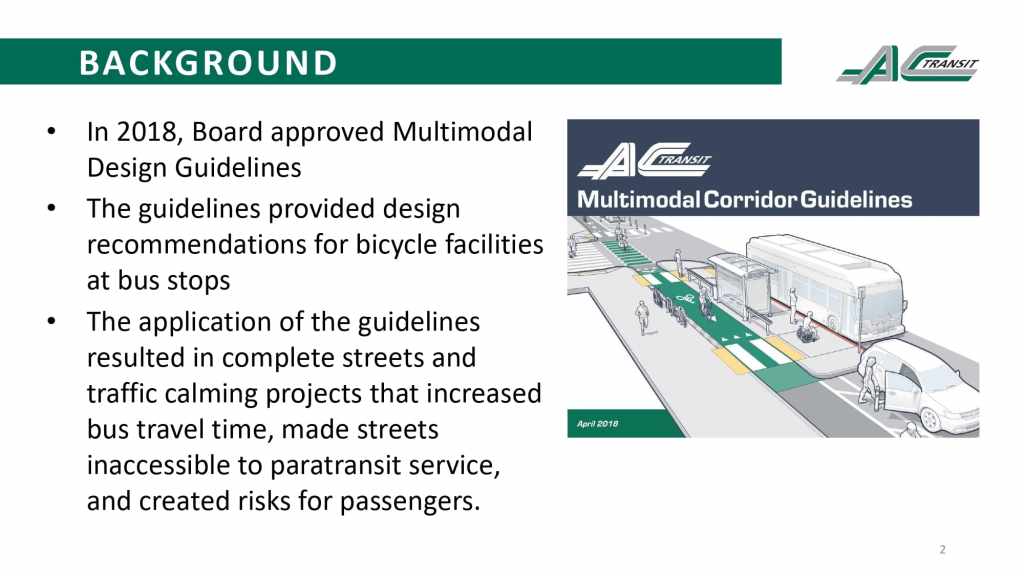
- In 2018, Board approved Multimodal Design Guidelines.
- The guidelines provided design recommendations for bicycle facilities at bus stops.
- The application of the guidelines resulted in complete streets and traffic calming projects that increased bus travel time, made streets inaccessible to paratransit service, and created risks for passengers.
Guideline elements
- Bus stops
- Dimensions – regular curb, curb extensions, boarding islands (with or without amenities), street with parallel parking vs street with diagonal parking
- Preferred stop locations (based on geometry, intersection control)
- Designs not compatible with transit
- Layover space (size, location, access to restroom etc.)
- Transit center standards (amenities, size, access to restroom, flexibility to add charging infrastructure)
- Roadway design, including transit lanes, and queue jumps
- Pedestrian access improvements to/from bus stops
- Paratransit operations and needs
Presentation




Presentation notes
- Update to previous guidelines – Meant to be a reference guide to staff for local projects.
- Unintended consequences from previous guide – Impacts on paratransit access, real or perceived safety impacts.
- First workshop will be scheduled within the next month or so. Will come back to BPAC infra committee later for further input before Spring 2024 draft document publication.
Discussion notes
- Discussion question – Preference between raised sidewalk level cycle tracks versus on-street protected bikeways?
- If higher pedestrian volumes, some separation between bike and pedestrian spaces is still needed.
- Design needed to encourage slower bike speeds.
- Raised bikeways are more expensive, so sometimes the design decisions are based on available funding, not the ideal facility.
- Raised bikeways don’t always have the same issue with debris or flooding as street level.
- Opportunity to talk about bus stop parking enforcement and disabled placard abuse & prioritize solutions via this plan to get ahead of the problem
- Look into accessibility design
- Ramping pedestrians from the sidewalk down to the street then back to a bus boarding island is a difficult engineering question. Oakland may be moving to more raised, level crossings between the sidewalk and boarding islands.
 Oakland BPAC Blog