
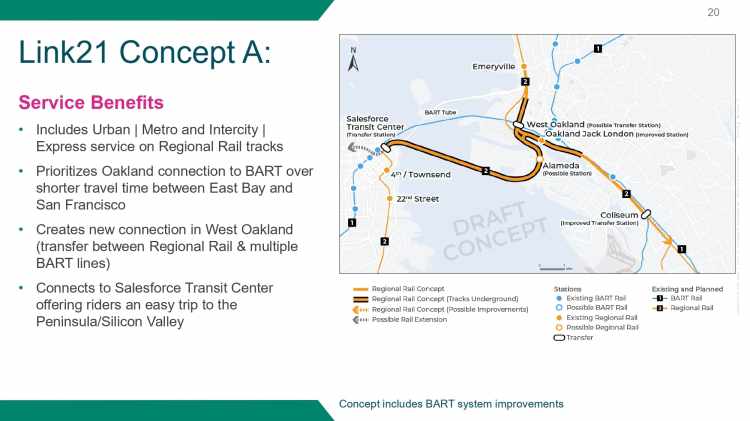
At the May 2, 2024 BPAC Infrastructure Committee meeting, Brian Soland and Darin Ranelletti from BART’s Planning and Development team will present an informational update on the Link21 project.
The Vision — Link21 and its partners will:
- Transform the BART and Regional Rail network into a more integrated system.
- Provide a faster, more connected, equitable, affordable, & accessible train service.
- Include a new transbay passenger rail crossing.
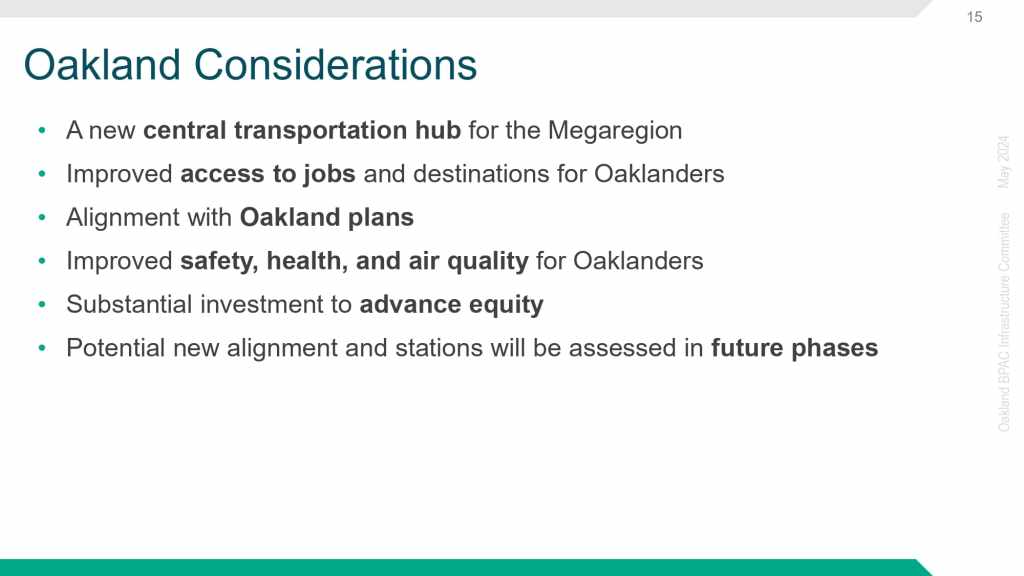
Oakland considerations
- A new central transportation hub for the megaregion
- Improved access to jobs and destinations for Oaklanders
- Alignment with Oakland plans
- Improved safety, health, and air quality for Oaklanders
- Substantial investment to advance equity
- Potential new alignment and stations will be assessed in future phases
The presentation is below, followed by notes from the presentation and discussion.
Presentation









Presentation notes
- Goal of providing more service, more destinations, new underground connection SF to East bay with connections to rail.
- Project team is taking info on project to public and joint power authority boards over next few months—here to coordinate with key stakeholders.
- Background: analyzing how new crossing could benefit megaregion
- Inequitable service that doesn’t meet needs of equity needs populations
- Congestion on key corridors; existing transbay capacity insufficient
- Limited service reliability
- Vision: Link21 and its partners will transform BART and Regional rail network into more integrated system.
- Faster, more connected, more equitable and affordable train service.
- Reaching decision point: Either a standard gauge crossing connected with the regional rail network (such as Caltrain and Capitol Corridor); or a broad gauge connection to the BART network.
- Goal is to transform passenger experience, promote equity / livability, support econ opportunity;
- Equity commitment: seeking to elevate equity in planning process—established an equity advisory council (including 4 members from Oakland).
- Oakland engagement
- Equity advisory council
- Monthly meetings with Oakland and port
- Community engagement events — such as rose foundation, open houses
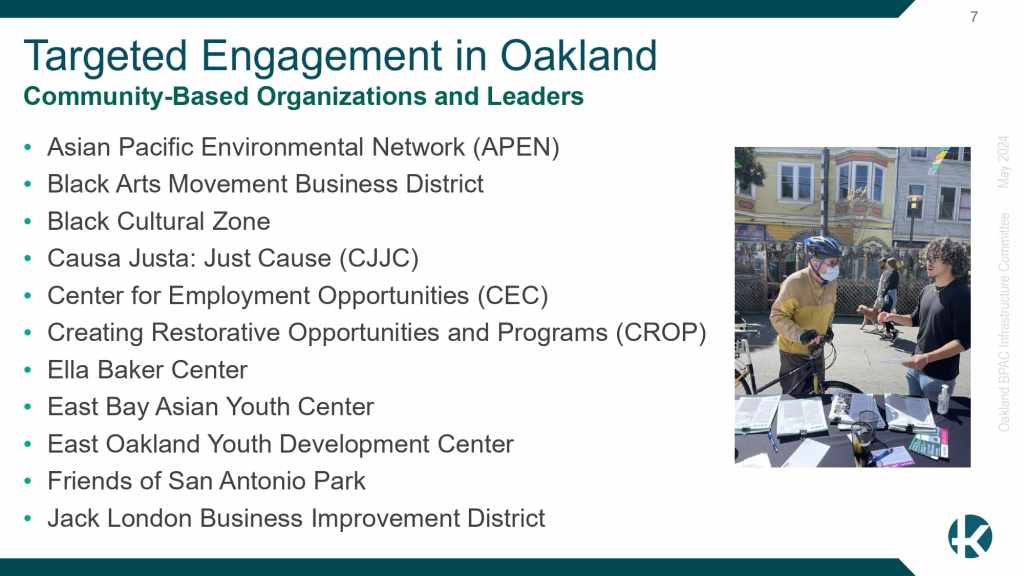
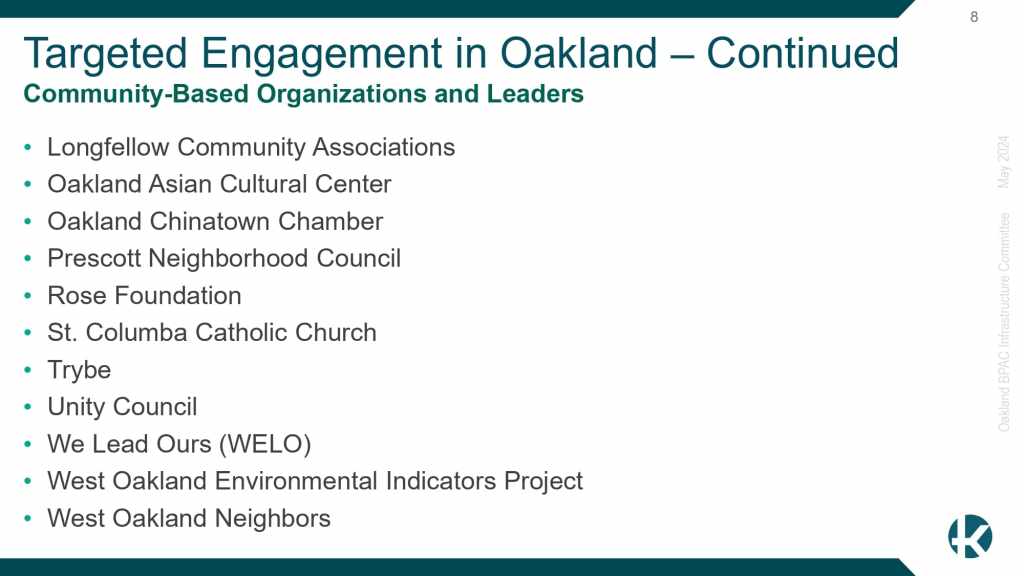
- Targeted engagement with some community based orgs and leaders
- Feedback:
- Need to improve rider experience, reliability, safety, affordability
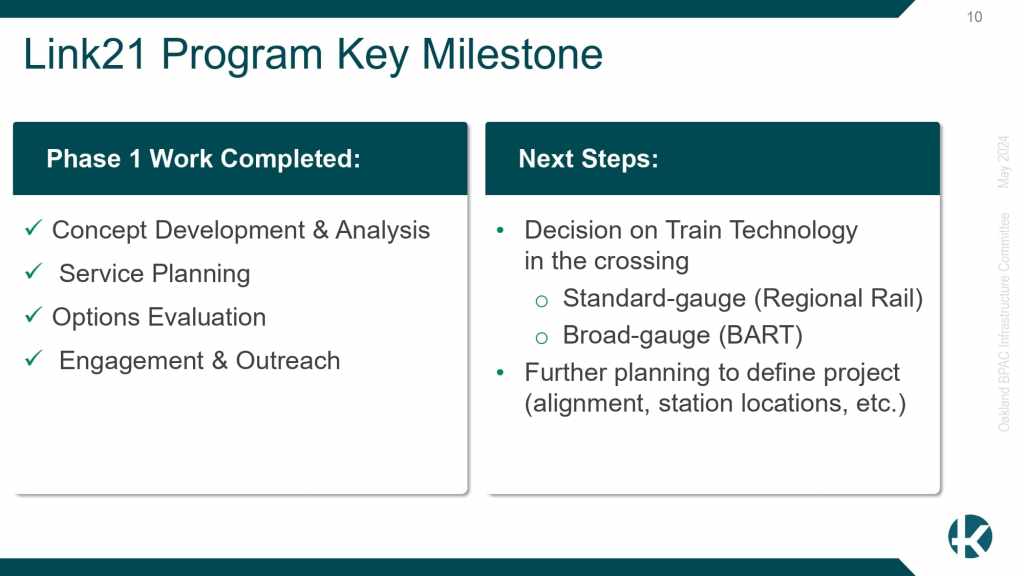
- Still in phase 1 of project planning (concept development and analysis, service planning, options evaluation, outreach.
- Next steps:
- Decision on train tech in the crossing (standard gauge v. Broad Gauge)
- Further planning to define project (alignment, station locations)
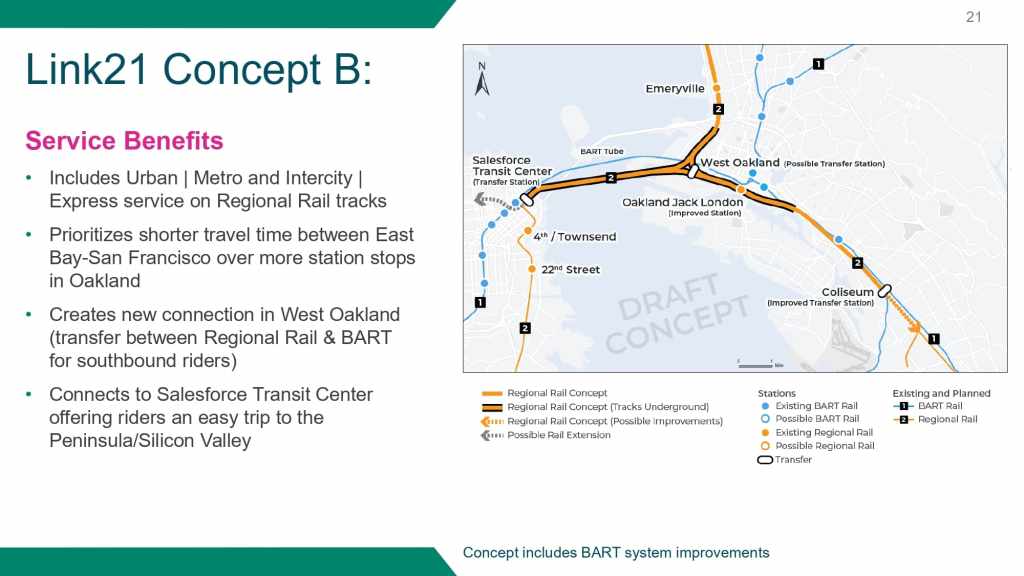
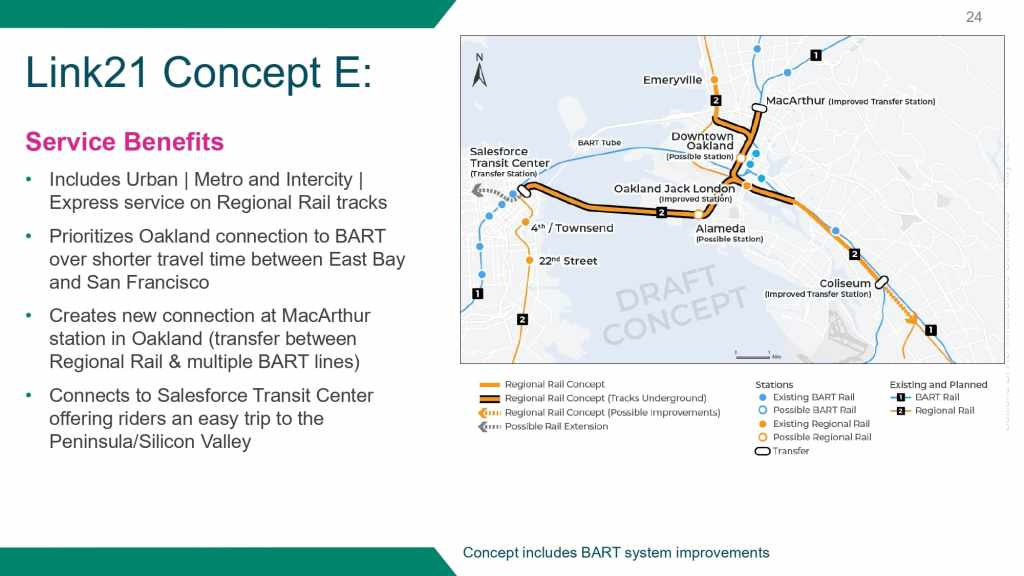
- Standard gauge crossing: connect with Capitol Corridor and Caltrain—including Caltrain in the urban metro service; gives a 2 for 1 opportunity—have 2 service types—could have fast BART like service using this service – potential for direct connections to peninsula;
- Benefits for Oakland: potential one seat rides between Oakland and the Peninsula, Emeryville, West Berkeley; faster and better connected rails service to Sacramento, Stockton, I-80 corridor; new rail transfer hub in Downtown Oakland; new alignment would be underground through Oakland.
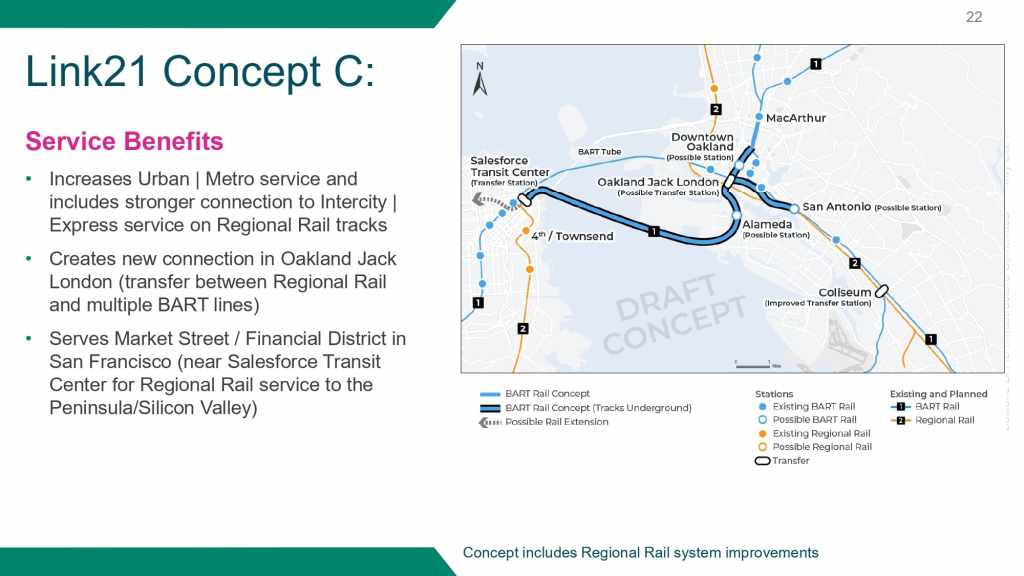
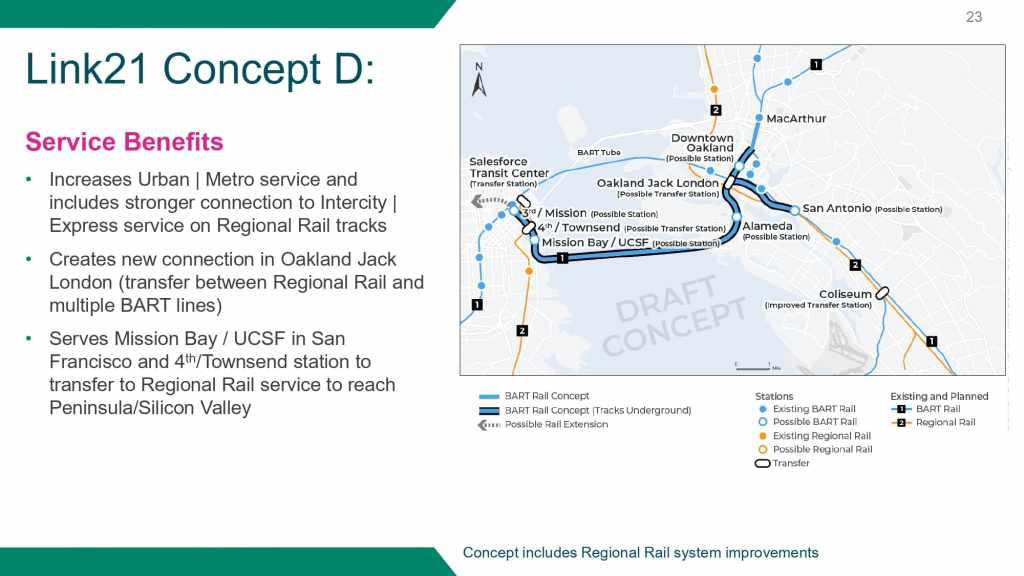
- Broad Gauge crossing: (accommodate only BART):
- Direct BART connection from Oakland to Alameda, mission bay, and SOMA – new transfer station at Jack London Square; heard interest in San Antonio infill station regardless of track gauge.
- Alignment would be underground.
- Findings so far:
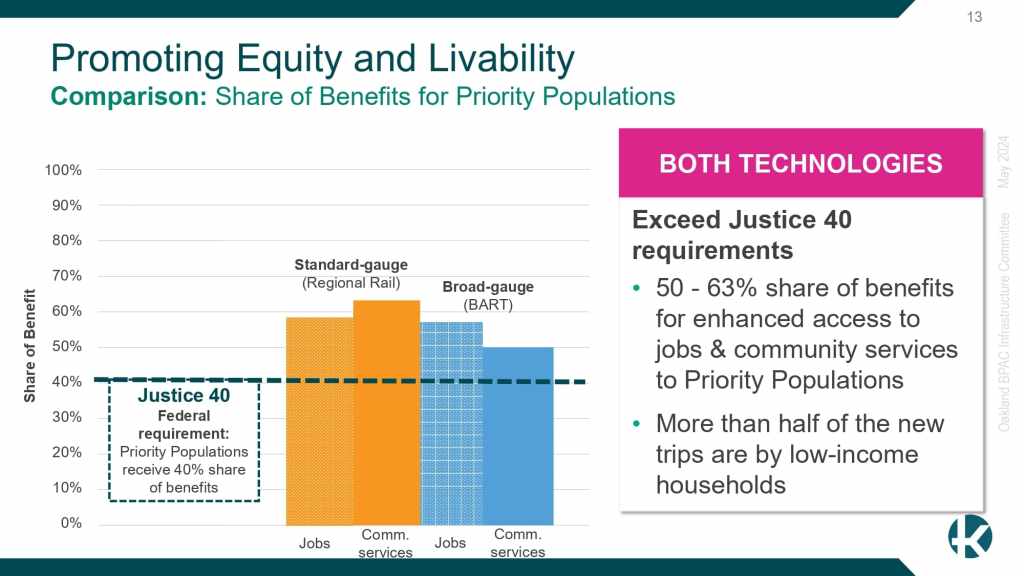
- Comparisons: both provide benefits beyond Justice 40 requirements.
- Majority of new trips in both options would be taken by low income households.
- Access to stations and jobs: both support economic opportunities.
- Oakland considerations
- A new central transportation hub for megaregions
- Improved access to jobs and destinations
- Alignment with Oakland plans
- Improved safety, health and air quality
- Substantial investment to advance equity
- Potential new alignment and stations will be assessed in future phases (thinking about wider land use integration and designs
- Next steps
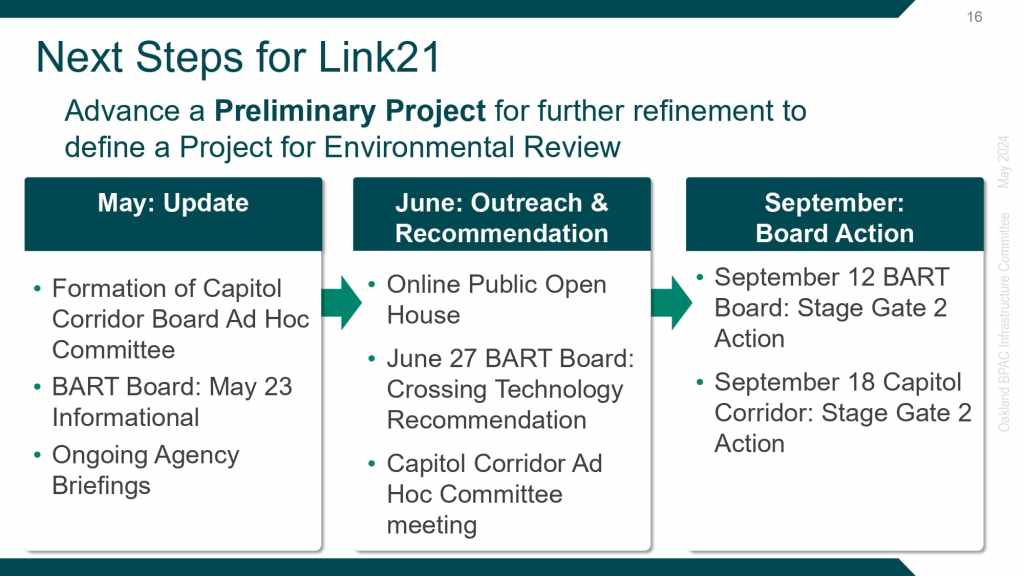
- May 23: update to BART board
- June 27: – BART board crossing technology recommendation
- Sept: back to BART board and Capitol Corridor for decision
Discussion notes
- How will they make the decision?
- Are there going to be two transfer points?
- Yes, Downtown Oakland and SF Transbay terminal.
- For a Jack London Square location, would it be close to amtrak?
- It’s too early to say (ideally would be aligned with existing station); potential for new below grade connection to Oakland (underground just south of Emeryville and continues below grade and come up along corridor between Coliseum and Fruitvale.
- Standard gauge crossing: would that just be capitol corridor?
- A: Governance not yet determined—could be Caltrain crossing into East Bay; Capitol Corridor trains could use—operator agnostic right now.
- Still very early to determine operating costs.
- Regional rail would make more sense to take super commuters off the freeways.
- Decision on track gauge is the primary issue for this year; the next stage is dependent on funding but could begin as early as this year or next year.
- Question about whether it would make sense to talk about i.e. adding bus only lane on bridge.
- There was a decision to focus only on rail in Stage 1.
- Is Caltrain a decision-making member?
- At this point it’s just BART and Capitol corridor but have a robust community engagement.
- There’s no 24-hour service now – would like to address this and the importance of Clipper integration.
- Having a second crossing connection could alleviate bottleneck for enabling late night service—discussing internally at BART—what other policy changes would be needed; it’s a step in the right direction. One crossing could cover service when another is out of service.
 Oakland BPAC Blog