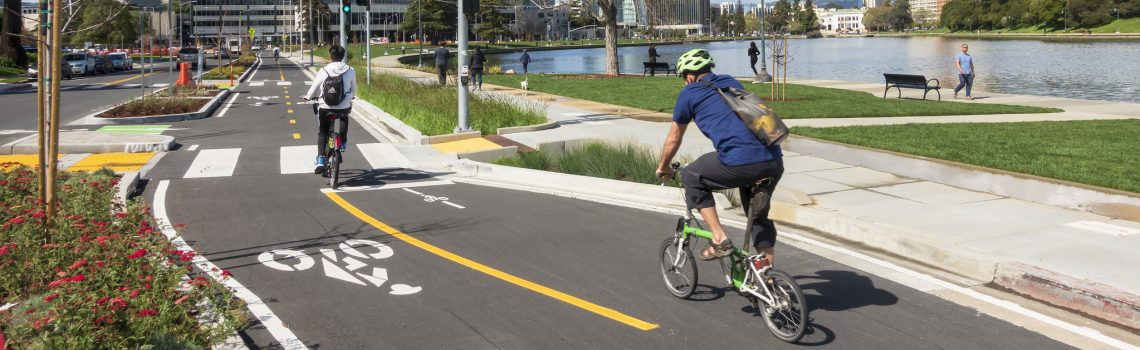
At the July 3, 2025 BPAC Infrastructure Committee meeting, OakDOT Bicycle and Pedestrian Program staff will present draft recommendations for a Slow Streets network in Oakland. Slow Streets were initially an OakDOT innovation during the COVID-19 pandemic to provide physically distanced outdoor spaces for residents. Staff are taking lessons learned from the pandemic and applying them to Oakland’s work-to-date developing bike boulevards and neighborhood bike routes (NBRs). Staff are proposing these routes be re-envisioned as slow streets for travel at human-powered speeds while simultaneously making these streets more welcoming for residents to use as public spaces. The presentation explains the purpose, planning criteria, and methodology for developing the draft Slow Streets network. View the interactive web map of the draft Slow Streets network.
An excerpt is below, followed by the full presentation.
Slow Streets
Slow Streets are for pedestrians, bicyclists, and micro-mobility users with limited local access for motor vehicles. Slow Streets provide public spaces for residents in Oakland’s neighborhoods. Slow Streets are slow in practice and in name. Slow Streets form a network for human-powered movement and play.
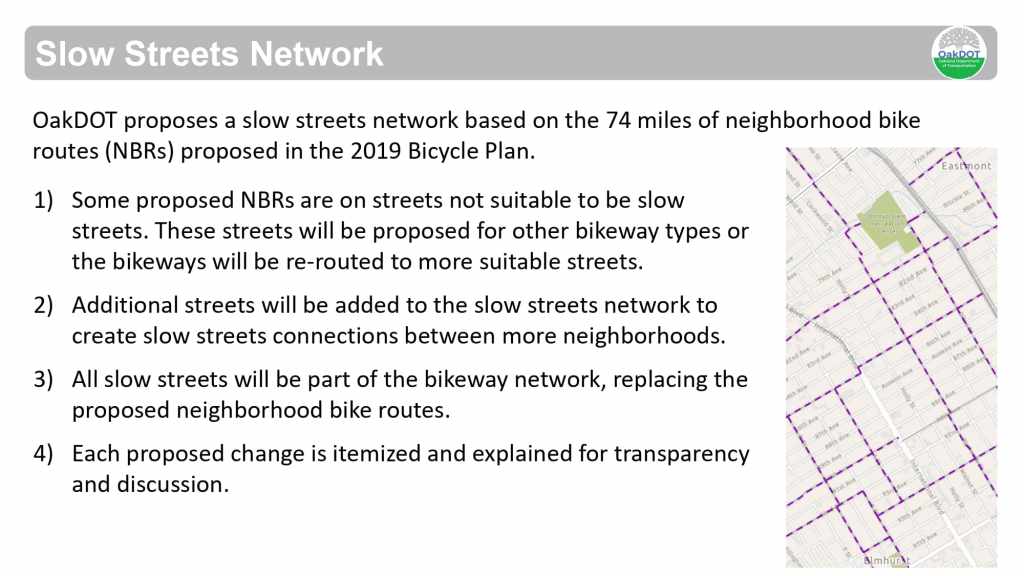
OakDOT proposes a slow streets network based on the 74 miles of neighborhood bike routes (NBRs) proposed in the 2019 Bicycle Plan.
- Some proposed NBRs are on streets not suitable to be slow streets. These streets will be proposed for other bikeway types or the bikeways will be re-routed to more suitable streets.
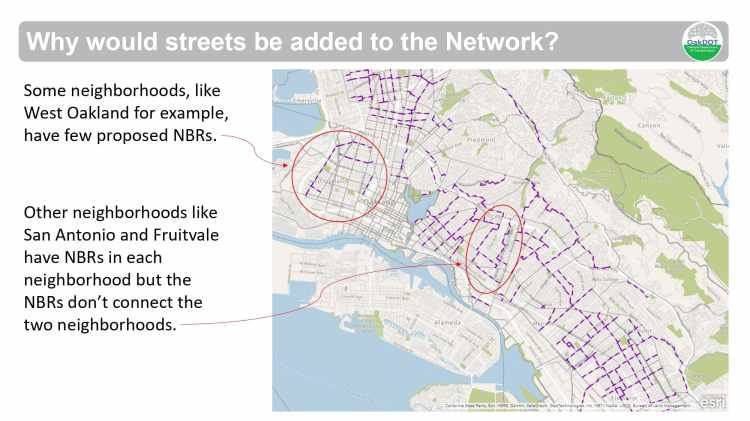
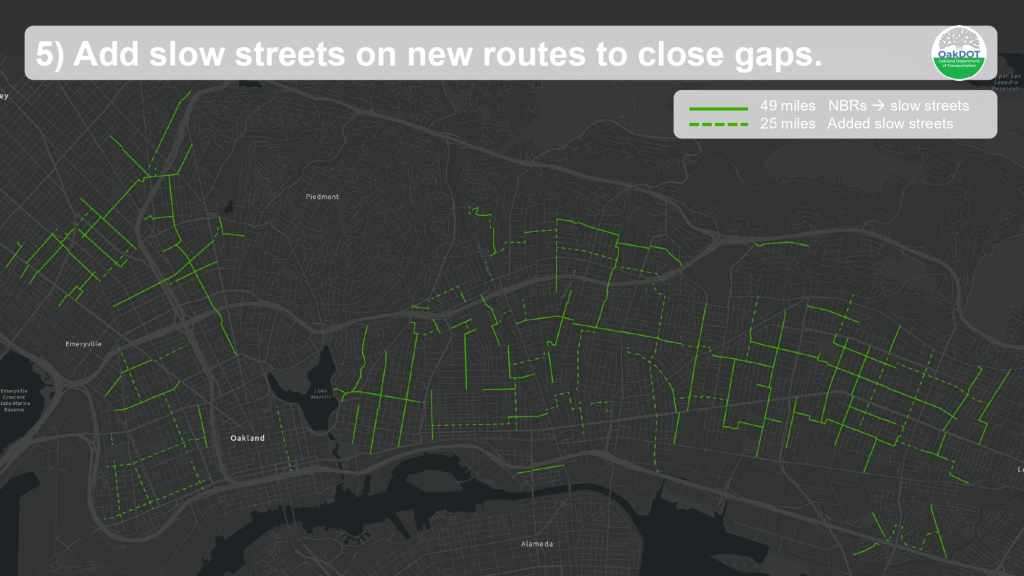
- Additional streets will be added to the slow streets network to create slow streets connections between more neighborhoods.
- All slow streets will be part of the bikeway network, replacing the proposed neighborhood bike routes.
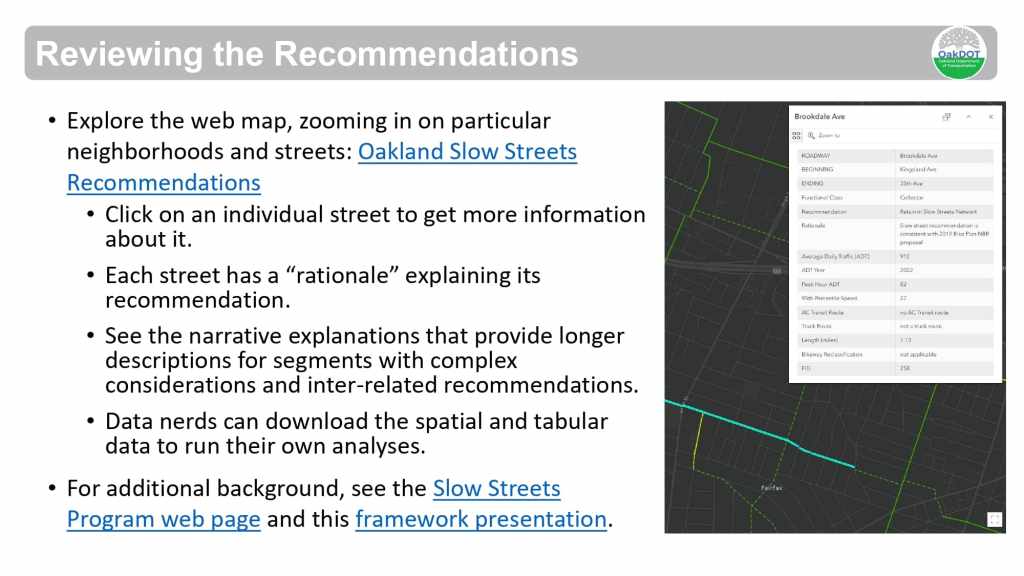
- Each proposed change is itemized and explained for transparency and discussion.
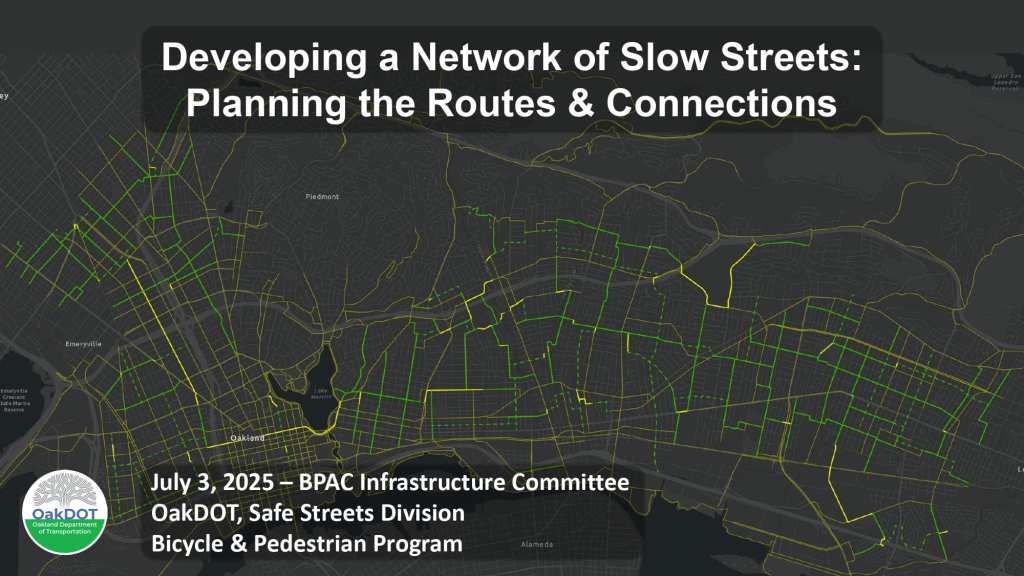
Planning the Routes & Connections
Bicycle & Pedestrian Program staff developed a step-wise process that builds upon the 2019 Bike Plan to propose a network of slow streets.
- Start with the 2019 Bike Plan’s bikeway network.
- Focus on the neighborhood bike routes (NBRs).
- Identify the NBRs well-suited to be slow streets.
- Retain the suitable NBRs as slow streets.
- Add slow streets on new routes to close gaps.
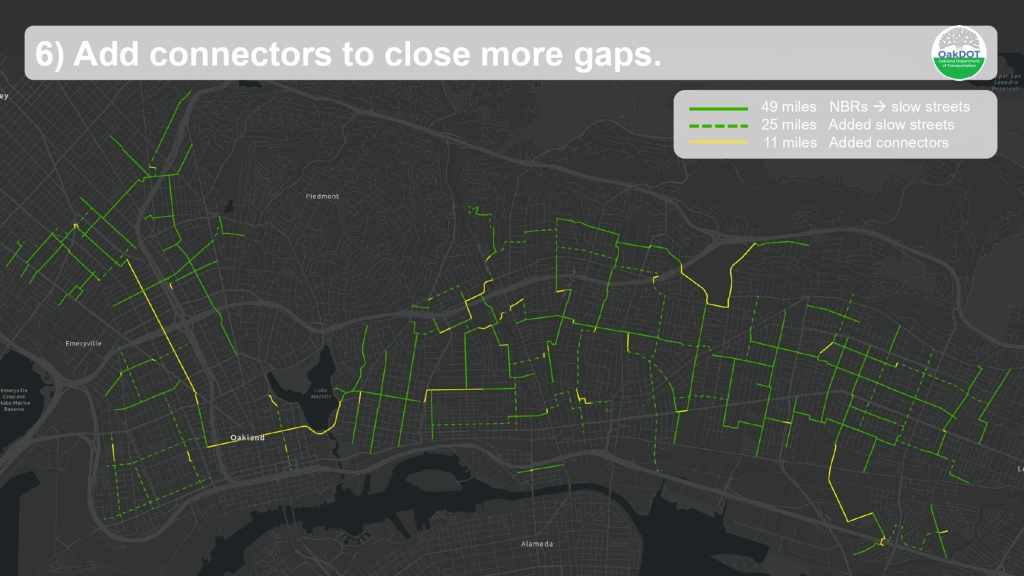
- Add “connectors” to close more gaps.
- A “slow streets connector” is a route suitable for all abilities (e.g., path, separated bike lane) where the connection cannot be made on a calm local street.
- Integrate slow streets into the bikeway network.
Public Review & Next Steps
OakDOT’s Bicycle & Pedestrian Program welcomes “big picture” feedback and input on specific streets.
- Provide comments to slowstreets@oaklandca.gov throughout summer 2025.
- Visit 8th Street in West Oakland, a demonstration project of slow streets.
This July 3, 2025 presentation is a soft launch to start public outreach. Next steps include:
- Announcements and a new web page in July 2025.
- Outreach through summer 2025.
- Revisions and additional review into summer 2026.
- Adoption of a slow streets network anticipated in fall 2026 or later.
Presentation






Slow Streets Network Analysis Recommendations – Narrative Explanations
OakDOT, Safe Streets Division, Bicycle & Pedestrian Program (5/6/25)




 Oakland BPAC Blog