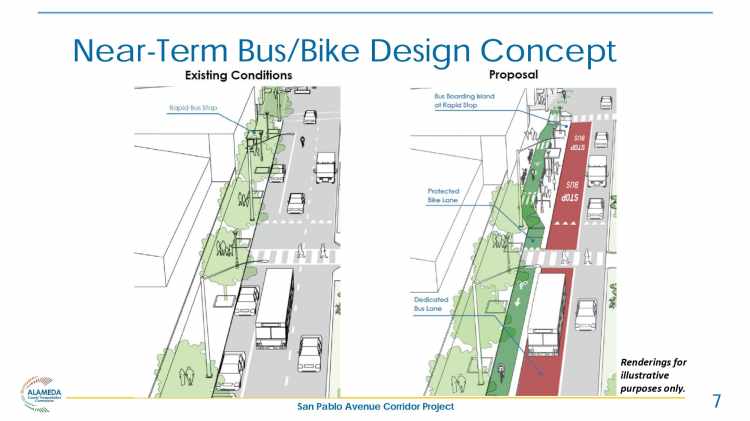
At the March 17, 2022 BPAC meeting, Alameda County Transportation Commission (ACTC or Alameda CTC) planner Colin Dentel-Post presented on the San Pablo Avenue Corridor Project. The project has completed a long-term visioning phase and has now embarked on a near-term implementation phase aiming to improve safety, transit efficiency, and placemaking along the corridor within 3-5 years.
The proposed project concept in Oakland, Emeryville, and South Berkeley includes pedestrian safety enhancements, conversion of one traffic lane in each direction to a dedicated bus lane, and conversion of each curbside parking lane to a protected bike lane. The project concept will go to the Oakland Public Works Committee and City Council later this spring for action.
Bike lanes: 16th Street to Heinz Ave
Bus lanes: 20th Street to Ashby Ave
An excerpt from the presentation is below, followed by the full presentation.
At the February 17, 2022 BPAC meeting, OakDOT Transportation Planner Julieth Ortiz presented an overview of existing Transportation Development Act (TDA) Article 3 projects and a draft project list for fiscal year 2022-23. This year’s recommendation is to use funding for existing programs/projects, including the bicycle parking program, bike signage, and the stairs and path program. OakDOT is seeking BPAC approval for this TDA cycle. Allocations for this fiscal year have not been received yet.
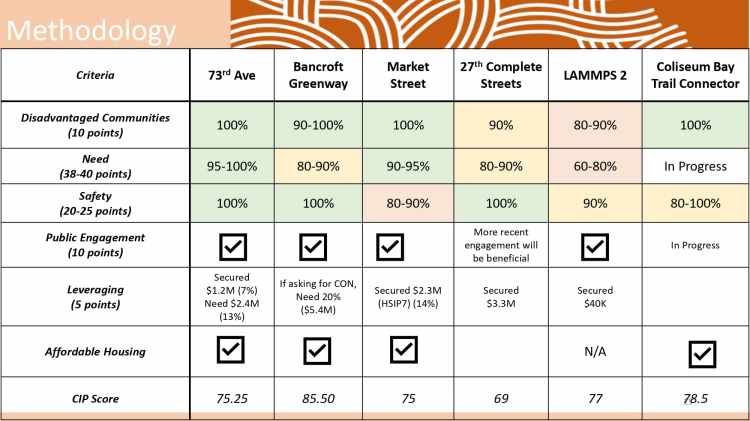
At the February 17, 2022 BPAC meeting, OakDOT Transportation Planner Julieth Ortiz presented on the proposed transportation projects for the Active Transportation Program (ATP) Cycle 6 and provide an update on the status of projects from previous ATP awards. ATP is a biannual competitive funding opportunity for projects that encourage increased bicycling and walking. The ATP is a state-administered program that distributes both state and federal funds. Applications for this year are due in June.
The projects currently under consideration are:
Bancroft Ave Greenway, Design (previously submitted, ATP Cycle 5)
73rd Ave – Active Connections to Transit, Construction
Coliseum Bay Trail Connector (66th Ave), Design & Construction (previously submitted, ATP Cycle 4)
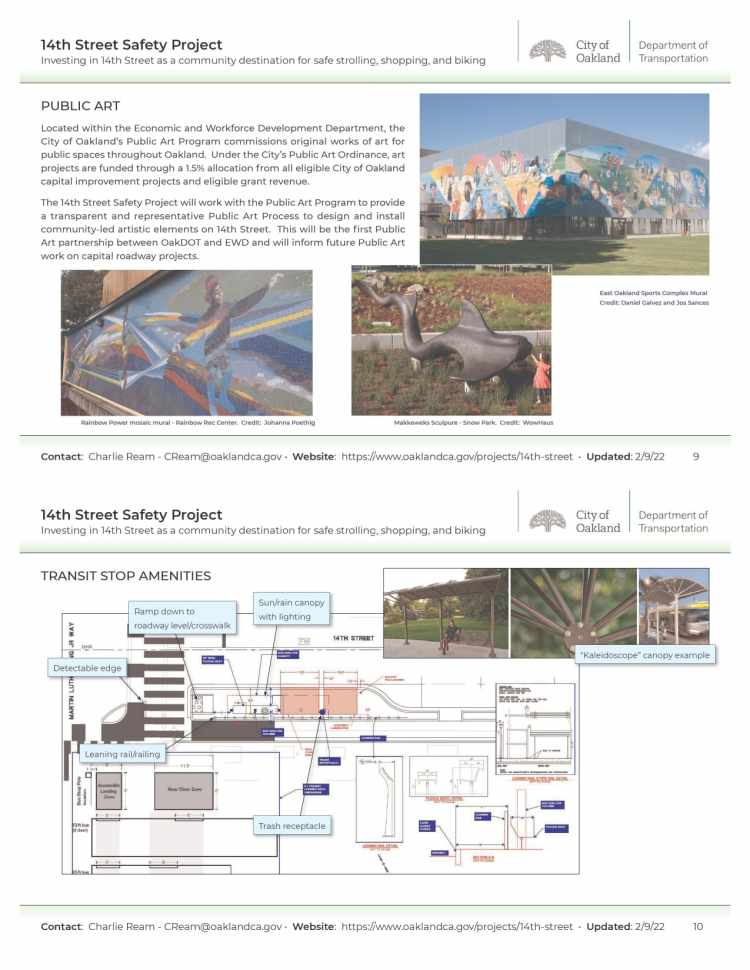
At the February 17, 2022 BPAC meeting, OakDOT Transportation Planner Charlie Ream presented on the 14th Street Safety Project. The project is proceeding toward 100% design in early 2022, with construction potentially beginning in early 2023. This roadway safety project will install protected bike lanes on 14th Street from Brush Street to Oak Street, take 14th Street from 4 to 2 vehicle lanes, shorten pedestrian crossings, and install new landscaping and sidewalk lighting. OakDOT is scheduled to bring the project to the Public Works Committee on 3/22/22 (date tentative).
At the January 20, 2022 BPAC meeting, Megan Wier and Jason Patton, OakDOT staff in the Safe Streets Division, will present on upcoming changes to the Slow Streets–Essential Places Program in response to the ongoing and changing nature of the COVID-19 pandemic. Changes include removing the temporary Slow Streets and Essential Places materials, including temporary street closures, and shifting efforts to longer term strategies for pedestrian safety and neighborhood traffic calming. The presentation is below.
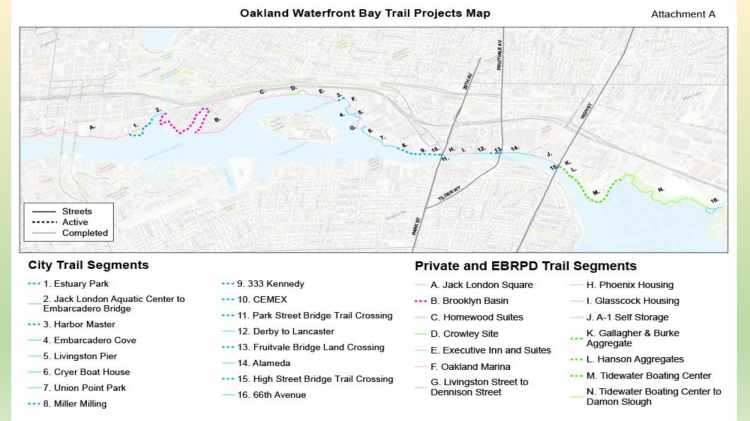
As part of the $198,250,000 Measure DD Bond, a General Obligation bond approved by Oakland voters in 2002, $43,500,000 of the Estuary Waterfront Access category is designated for waterfront trail and parks acquisition and construction. Through this category of funding, Oakland is completing local segments of the regional San Francisco Bay Trail, a 500-mile walking and cycling path around the San Francisco Bay that passes through 47 cities and all nine Bay Area counties. The City has completed several segments and is in various stages of design on the remaining segments that still need to be constructed to close the Bay Trail gaps in Oakland.
At the November 18, 2021 BPAC meeting,Colin Piethe presented on the Walk This Way Toolkit. The Walk This Way Toolkit for underpass improvements is a project that was led by the Department of Planning & Building in 2016, and is now managed by the Department of Transportation. The toolkit is aimed at helping developers, City staff, and members of the public have a 1) menu of design tools to address the dark and uninviting nature of underpasses and 2) guidance on how to navigate internal and external processes for improving underpass areas.
Study area: the toolkit studies 4 underpasses to develop design solutions and agency navigation for underpass improvements.
Oakland has over 85 pedestrian-accessible underpasses across 5 freeways.
The City’s Department of Race and Equity’s Oakland Equity Map visualizes priority neighborhoods and pedestrian high injury corridors.
The existing conditions study identifies negative sensory impacts & common characteristics of underpasses.
The existing conditions summary identifies patterns in the built environment that influence a pedestrian’s experience.
The toolkit organizes design solutions in categories guided by agency jurisdiction and permitting processes.
The full presentation and summary of discussion are below.
At the November 18, 2021 BPAC meeting, Lucas Woodward will discuss the various ways that the Safe Streets Traffic Engineering team works to further school traffic safety in Oakland, including current and future projects and challenges. Read more here about traffic safety efforts near schools at OakDOT.
Power the People: Martin Luther King Jr. Shoreline Access Study, is a project that will explore the feasibility of creating a new Non-Fare zero emissions bus route along 73rd Ave and other clean mobility options that will bring East Oakland residents from 94603, 94605 and 94621 zip codes to the Martin Luther King Jr. Shoreline park. In the belief that the same neighbors of East Oakland deserve better neighborhoods, this project aims to model how community can plan for improvements without displacing existing low-moderate income BIPOC residents.