At the August 19, 2021 BPAC meeting, Sarah Fine, OakDOT Paving Program Manager, provided the biannual update on the 2019 3-Year Paving Plan. An excerpt is below, followed by the full presentation.
3-Year Paving Plan — Remaining
40+ Miles Local Streets
Fall 2021 Major Projects (6+ Miles)
W Grand Ave (Mandela to Market)
West St (W Grand to MLK)
E 15th St & Foothill (1st Ave to 14th Ave)
Telegraph (29th to MacArthur)
Spring 2022 Major Projects (2+ Miles)
Broadway (6th to 11th, 20th to Grand Ave)
High St (Foothill to Tompkins)
3-Year Paving Plan — Not Deliverable by June 2022
Major Projects (7+ Miles)
14th St (Brush to Oak) (ATP Grant Coordination)
52nd St (MLK to Shattuck) ([Lack of] Staff resources)
7th St (Mandela to Market) (ATP Grant Coordination)
Broadway (Embarcadero to 6th) (Pending Oakland A’s)
Franklin (6th to Broadway) (Staff resources)
Grand Ave (Broadway to MacArthur) (Staff resources)
Lakeside Dr (Jackson to E 12th St) (Staff resources)
MLK (47th to City Limit) (Staff resources)
Draft 2022 5-Year Paving Plan
Develop 5-year street list and 10-year capital plan to bring Oakland streets to average PCI 60
Deliver $300M+ in paving construction Rehabilitate and maintain local streets to improve neighborhood quality of life
Identify staffing and capital facilities needs to sustain long-term in-house program
Anticipate a second bond measure and identify consequences of failed measure
At the July 17, 2021 BPAC meeting, Kerby Olsen, New Mobility Supervisor at OakDOT, introduced the Zero Emission Vehicle (ZEV) Action Plan and the upcoming Electric Bike Library. Topics explored in the ZEV Plan include the installation of electric vehicle chargers in the public right of way, increasing access to ebikes and e-scooters, and encouraging cargo bike delivery services. The Electric Bike Library is a grant-funded, $1,000,000 project to purchase 1,000 electric bicycles and make them available for medium- or long- term rental at low cost through existing bike shops and bike programs.
At the July 17, 2021 BPAC meeting, BPAC Chair Andy Campbell will provide an overview of the BPAC recruitment process for 2022, lead a discussion on outreach, and seek volunteers and a motion to create a recruitment committee.
At the June 17, 2021 BPAC meeting, Laura Kaminski, Acting Strategic Planning Manager, gave an update on existing and new projects including: the Downtown Oakland Specific Plan, an Impact Fee Update, and a General Plan Update.
Downtown Oakland Specific Plan (DOSP) — Mobility Objectives:
Improve access and safety for pedestrians;
Create a world-class transit network linking Oaklanders to downtown
Develop a connected network of low-stress bicycling facilities
See map (in presentation) of Proposed Low-Stress Short-Term and Vision Bicycle Networks
Transportation Impact Fee 5-Year Update:
Update fee schedule from 2016 nexus study based on inflation along with Appendix B – what is necessary to fund cumulative CEQA traffic mitigation costs.
Provide additional fee schedule to fund list of potential citywide transportation projects not included in Appendix B.
Provide additional fee schedules to fund list of specified transportation projects included in the (1) Downtown Specific Plan (DOSP) and (2) Waterfront Ballpark District at Howard Terminal Project (offsite transportation projects, not direct impacts of Howard Terminal project)
General Plan Update Schedule
2021 spring and summer: Approach and Consultant Team Selection
General Plan Update Memo
RFP for Consultant Team (Council – September)
Backbone CBO as part of consultant team
2021 fall: Official Kick-off
2023, January: Adoption of Housing, Safety, and Environmental Justice Element
2025, July: Adoption of Land Use, Transportation, Noise, Open Space, Conservation, and Recreation Elements
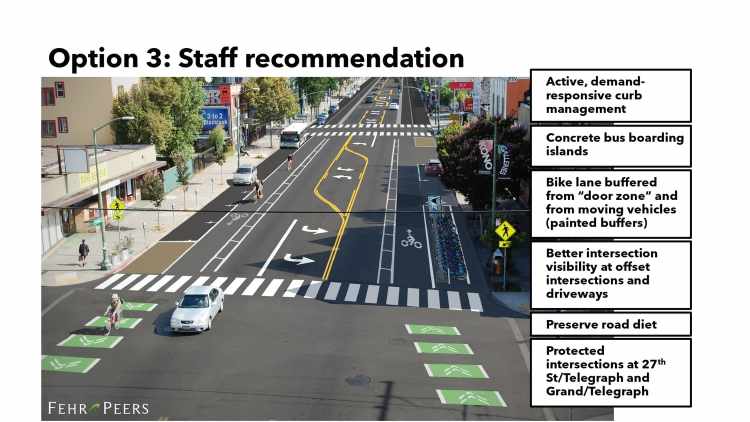
At the June 17, 2021 BPAC meeting, Ryan Russo, Director of the Oakland Department of Transportation (OakDOT), presented a brief history of bike facilities on Telegraph Avenue in Koreatown Northgate (KONO); provided an overview of what we’ve learned since the installation of an interim project in 2016; and presented an overview of the proposed recommendation to install enhanced buffered bike lanes with active curb management, which City Council will consider later this month. Director Russo shared how the public can continue participating in the Telegraph Avenue Complete Streets Project.
What we’ve learned (2013-2019)
The good:
The number of people walking and biking doubled
People driving are three times more likely to yield to people crossing the street
People walking and biking report feeling safer with the bike lane than with the five-lane condition
Motor vehicle volumes have remained steady, but 85th percentile speeds have decreased closer to the posted speed limit of 25 mph
The less good:
Reported collisions involving people walking and biking increased by 33%
People driving park in the bike lane
Bike lane and intersection visibility concerns
Pedestrian visibility concerns
Anecdotal reports of increased near-miss collisions
Maintenance challenges
Businesses report negative impacts
Aesthetic concerns
The full presentation and summary of discussion are below.
At the June 17, 2021 BPAC meeting, BPAC Commissioner David Ralston will announce an upcoming Rebuilding American Infrastructure with Sustainability and Equity (RAISE) federal planning grant opportunity to support green infrastructure and active transit connections along the I-880 corridor in East Oakland. This plan would include potential freeway lid crossings to provide equitable access for East Oaklanders to the Bay Trail and waterfront as well as co-beneficial emission reduction and carbon capture opportunities. Ralston will be seeking a letter of support from the BPAC.
Project background
The Bay Area Air Quality Management District (BAAQMD), working with regional partners such as MTC and the State DOT, is preparing a planning grant application for this year’s round of federal RAISE infrastructure funding. The RAISE program (Rebuilding American Infrastructure with Sustainability and Equity) is a federal grants program previously known as BUILD. This program provides $1 billion in federal FY 2021 discretionary grant funding for capital projects and planning projects.
The proposed planning project focuses on the heavy-diesel “goods movement” corridor of the I-880 Freeway as it passes through the severely impacted environmentally justice disadvantaged communities of greater East Oakland (Estuary to 105th Ave., an approximately 5-6-mile segment). The project will undertake planning feasibility, technical assessments, and conceptual-development designs for utilizing Caltrans (State) ROW along this corridor for the innovative installation of co-beneficial green infrastructure that can:
Mitigate/reduce PM, Black Carbon and other Diesel emissions (as well as noise) to adjacent communities;
Sequester carbon and GHG from vehicular traffic;
Provide vegetative canopy to reduce urban heat island;
Enhance the capacity of groundwater recharge and provide flooding mitigation;
Enable and fill key active transit network gaps (such as connections between local neighborhoods, the East Bay Greenway and the Bay Trail);
Provide opportunity for green jobs works programs.
At the May 20, 2021 BPAC meeting, Nicole Ferrara, OakDOT’s Policy & Intergovernmental Affairs Advisor, presented on and shared ways the BPAC can support two bills aimed at reducing dangerous speeding on California roadways that the State Legislature is considering: Assembly Bill AB 43 (Friedman): Speed Limit Setting, and AB 550 (Chiu): Speed Safety Systems. Both bills would implement Safe Oakland Streets (SOS) strategies, and the bills have been supported by City Council and the Mayor.
Safe Oakland Streets: Goals
Prevent severe and fatal crashes and related disparities impacting Black, Indigenous, and People of Color (BIPOC) communities, seniors, people with disabilities and low-income populations
Eliminate severe and fatal injury inequities including racial disparities impacting BIPOC communities that exist today in Oakland
Inform effective and equitable safety strategies that prevent injury and injury inequities, and do not have adverse equity impacts on BIPOC communities, seniors, and low-income populations
Current status of state legislation
AB 43 passed out of the Assembly and heads to the Senate.
AB 550 was held in Assembly Appropriations today (May 20, 2021) and won’t advance this year.
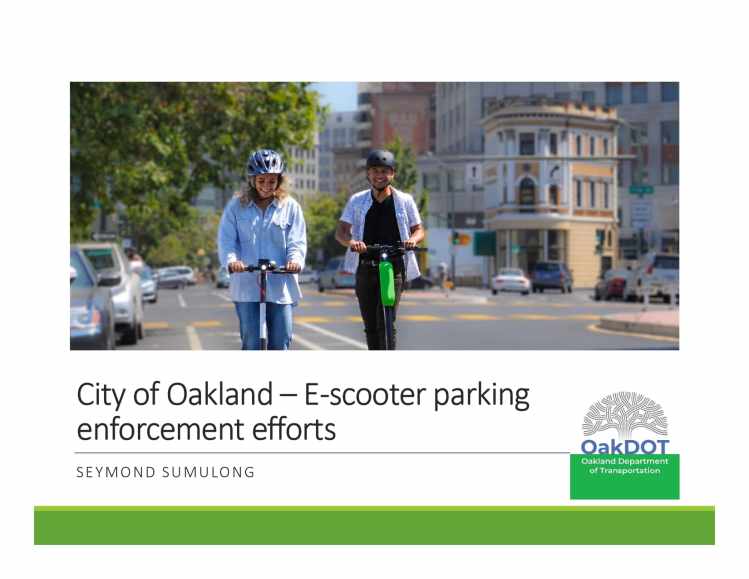
At the May 20, 2021 BPAC meeting, Kerby Olsen, New Mobility Supervisor, gave a quick update on the E-scooter program and introduced two of the three new permitted operators: SPIN, VeoRide and LINK. Seymond Sumulong, Construction Inspector, gave an update on E-scooter parking enforcement and the effectiveness of the locking requirement.
Scooters with locking devices
Starting November 2020, shared e-scooters were required to lock to a bike rack, in-street corral or City street signs when not in use.
Before the locking devices were required, there were an average of 37 issues that were reported in OAK311 per month and an average 8 per month resulted to fines.
After the locking devices were required, there were an average of 32 issues that were reported in OAK311 per month and an average 0 per month resulted to fines.




 Oakland BPAC Blog